A falling complaint count is easy to read as good news. Sometimes it is. But complaint volume measures two things at once: how often riders have a problem, and whether they still think telling you is worth the effort. When the second number drops, the inbox gets quiet while service stays the same. This post is about that second number, and the habits that keep it healthy.
Why riders stop writing
A rider who sends feedback is doing the agency a favor. They took time to describe a problem, often while still annoyed. What happens next decides whether they ever do it again.
If they hear nothing, they draw a simple conclusion: nobody read it. If they get an automatic "thank you for your feedback" and then nothing, the conclusion is the same, only slower. Few riders will write a second time into silence.
Those riders do not stop having opinions. They take them somewhere else. They post on social media, speak at a board meeting, write to an elected official, or quietly start driving. None of those channels come with a case number, a route, or a time of day that your team can act on.
What a quiet inbox can hide
A drop in feedback deserves a question before a celebration. Look at a few things together:
- Repeat senders. Are riders who wrote once writing again? A shrinking pool of repeat senders can point to riders giving up.
- Other channels. Are social media mentions, board comments, or calls to elected officials steady while formal feedback falls?
- Commendations. Riders stop sending praise too when they think nobody reads it. A drop in commendations is a warning, not a detail.
- Response records. How many recent cases closed without a reply to the rider?
If complaints fall while these signs move the wrong way, the problem is trust, not service.
Four habits that close the loop
None of these steps needs a new program or a new budget line. They need an owner and a standard.
- Acknowledge every submission.
- Tell the rider what changed.
- Give operators their commendations.
- Publish a short "you said, we did" summary.
1. Acknowledge every submission
Every rider who writes in should get a reply that shows a person read it. A case number helps. So does one sentence that names the actual problem: "the 7 passing you at Oak and 3rd on Tuesday morning". That line shows the rider the message was read, not just received.
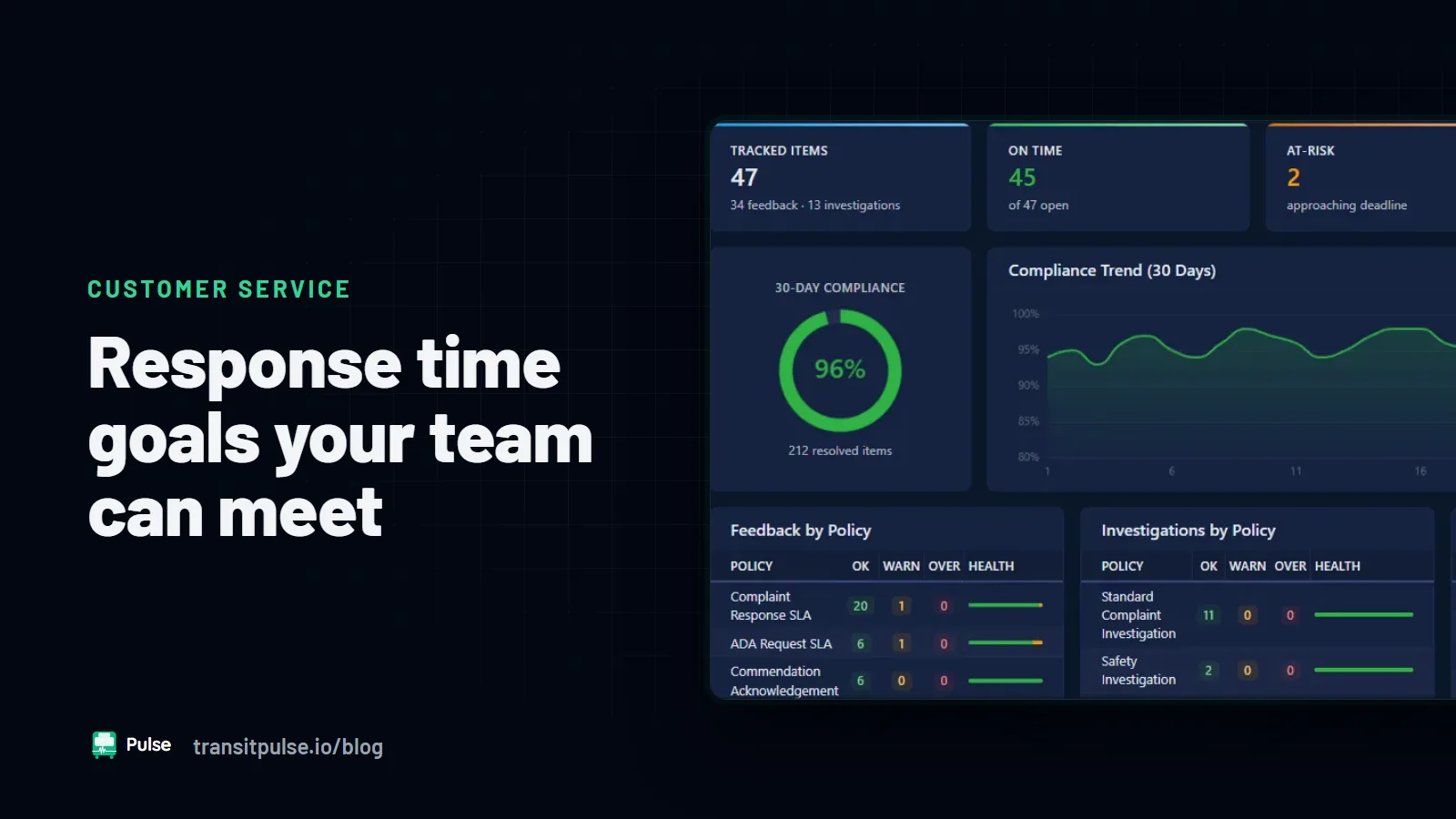
Set a response time goal your team can keep, and track it. A goal the team misses every week is worse than a modest one met every time. We cover how to set that goal in Response Time Goals for Rider Feedback That Your Team Can Meet.
2. Tell the rider what changed
The closing reply matters more than the first one. Tell the rider what the agency found and what it did, within what you are allowed to share. You may not be able to say how an operator was coached. You can say that the report was investigated, that the operator's supervisor reviewed it, and that the matter was addressed.
When nothing could change, say so and say why. "The stop cannot move because the sidewalk there does not meet accessibility requirements" is a real answer. Riders accept a clear "no" far better than silence.
Avoid replies that could go to anyone. "We take all feedback seriously" tells the rider that nobody looked.
3. Give operators their commendations
Commendations are feedback too, and the loop has two ends. The rider who praised an operator should get a thank-you. The operator should hear about it, in the rider's own words, and soon.
- Send the commendation to the operator and their supervisor, not only to a file.
- Use the rider's words, with personal details removed.
- Follow your agency's practice and any labor agreement on how commendations are recorded.
- Track commendations by route and garage, the same way you track complaints.
Operators who see their commendations know the feedback system is not only a way to catch mistakes. That helps when a complaint investigation needs their cooperation. Clear feedback categories make this easier. See Complaint, Commendation, Inquiry: Feedback Categories That Mean Something.
4. Publish a short "you said, we did" summary
Individual replies reach one rider each. A public summary reaches everyone, including riders who never wrote in. Keep it short, keep it regular, and keep it concrete. Monthly or quarterly both work, as long as it does not stop.
A format that works on a web page, a rider newsletter, or a board packet looks like this:
You said: The shelter at the transit center has no lighting after dark.
We did: Facilities installed new lighting. It is on from dusk to dawn.
You said: Buses on the 15 leave the hospital stop before the posted time.
We did: Supervisors checked departure times at that stop, and operators received a reminder about timepoints.
Pick items riders will recognize. Include at least one where the answer was "not yet" and say what is in the way. That honesty is what makes the rest of the list believable.
Make the loop hard to skip
These habits fail when they depend on memory. Build them into the process: no case closes without a reply to the rider, every commendation has a named person who forwards it, and the summary has an owner and a date on the calendar.
Pulse Feedback keeps each case on one screen, with its owner, its investigation steps, and what the rider was told. Staff reply to the rider from the case, and riders can check a case from the agency's portal. Commendations have their own type and process, and SLA tracking flags cases at risk of missing a response target. See how it works on the Pulse Feedback page.