A board member asks a fair question: did complaints about one route go up after the service change? The customer service manager opens the feedback report. The largest category is "General." The next one is "Bus Issue." A third is "Other." Nobody can answer the question from that data, and the manager spends two days reading records by hand.
The problem is not the report. The problem is the category list that staff used at intake. Good categories make reporting easy. Poor categories make every report a research project. This post covers how to build a category list that holds up.
Start with three types
Every piece of rider feedback asks the agency for one of three things. The first question at intake is which one.
- Complaint. The rider says something went wrong and expects the agency to act. A complaint needs an owner, often an investigation, and a response.
- Commendation. The rider praises an operator, a staff member, or a part of the service. A commendation needs to reach the person it names.
- Inquiry. The rider has a question, such as a fare rule or a schedule. An inquiry needs an accurate answer, and then it closes.
These three types follow different workflows. A complaint about an operator can lead to a supervisor review. An inquiry about Sunday service should never enter that process. When the types mix, the complaint count includes questions, and the response times look worse than they are.
Some submissions contain more than one thing. A rider asks when the next bus comes and also complains about the last one. Pick the type by what the rider needs most from the agency. In this case, file a complaint and answer the question in the response. Write this rule down so every calltaker applies it the same way.
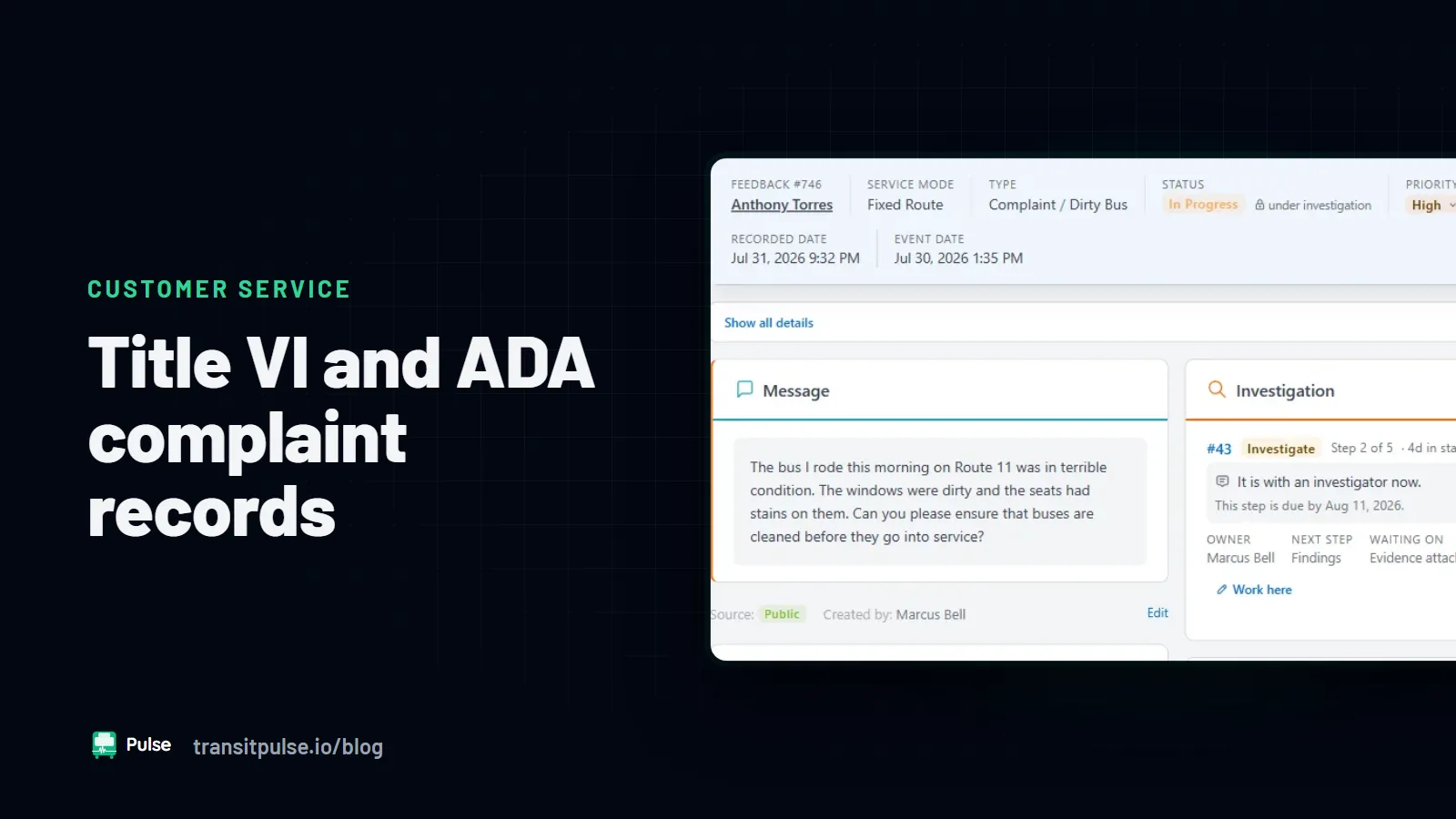
Title VI and ADA complaints need their own flag on top of the type. They follow a separate process and a separate record. We cover that in Title VI and ADA Complaints: Keeping Records You Can Stand Behind.
Add subcategories for what the feedback is about
The second level tells you which part of the service the rider means. For most fixed-route agencies, four subcategories are a good starting point.
- Route. Late trips, missed trips, crowding, schedule gaps, and detours.
- Operator. Conduct, driving, pass-ups, and help with boarding.
- Stop. Shelters, signs, lighting, snow removal, and stop locations.
- Vehicle. Cleanliness, temperature, lifts and ramps, and announcements.
Each subcategory should also collect the identifier that goes with it. A route complaint needs the route number and direction. An operator complaint needs the operator ID or the vehicle number and time, so staff can find the operator. A stop complaint needs the stop ID or the intersection. A vehicle complaint needs the vehicle number.
These identifiers matter more than the category name. With them, you can count complaints for one route or one operator. Without them, you can only count complaints in general.
How poor categories break board reports
Board reports usually fail in a few predictable ways.
- "Other" is the largest category. Staff choose it when the list is too long or the definitions are unclear.
- Categories overlap. "Late bus," "Schedule," and "On-time performance" all describe the same problem. Staff split the same issue three ways, and each count looks small.
- Categories follow the org chart. Names like "Maintenance" or "Planning" describe a department, not the rider's problem. They also change when the org chart changes.
- Categories change without a map. Someone renames or merges categories. The trend line breaks, and nobody can compare one quarter with the next.
Practical rules for a category list
- Keep the list short. Staff choose quickly from a short list. With a long list, they choose the first item that fits, or "Other." If the list does not fit on one screen, it is too long.
- Give each category one owner. The owner is a role, not a named person. The owner writes the definition, answers for the backlog, and approves any change.
- Write a definition and an example. One sentence says what belongs. One example shows a real case. Put both where calltakers can see them during intake.
- Review the "Other" bucket every month. Read every record in it. Move each record to the right category if one exists. If a pattern appears, add a category or fix a definition.
- Count commendations and route them. Send each commendation to the operator it names and to that operator's supervisor. Report commendations next to complaints, by route and by operator. A report with only complaints gives the board half of the picture.
- Change the list on a schedule. Make changes at the start of a reporting period, not in the middle. Keep a map from each old category to its new one, so trends still work.
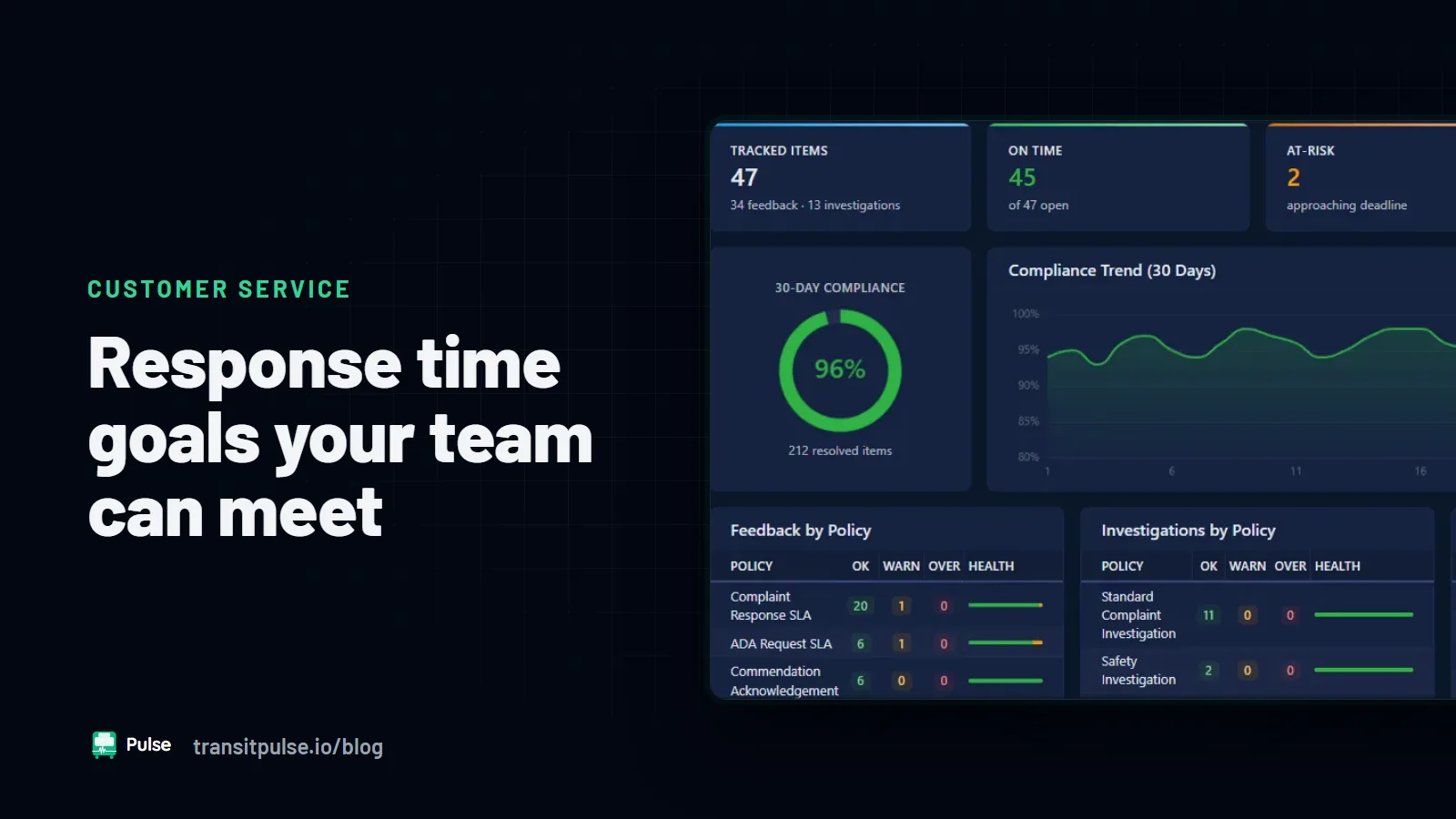
A clean list also makes response-time goals possible. You cannot set a target for operator complaints if half of them sit in "General." See Response Time Goals for Rider Feedback That Your Team Can Meet for that next step.
Test the list before you commit
Before you change the list, take a sample of recent feedback. Ask two staff members to categorize the same records separately. Compare their answers. Where they disagree, the definition is unclear. Fix the definition and test again. This small exercise finds most problems before they reach a board report.
Where Pulse Feedback fits
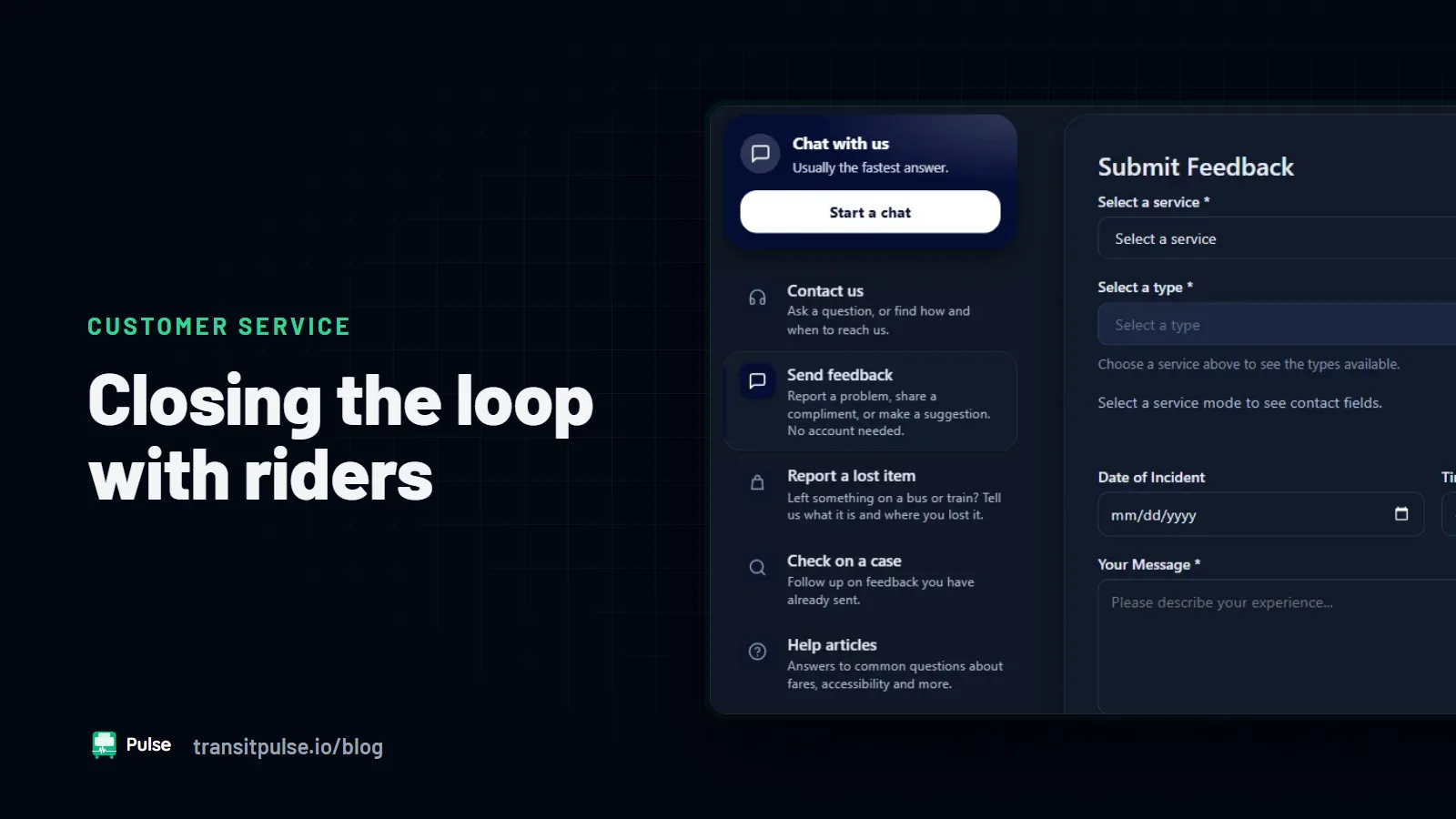
Pulse Feedback handles complaints, commendations, inquiries, and ADA requests. Each type has its own fields and its own process. The rider portal's feedback form uses service and type pickers from the agency's own configuration. Pulse Feedback categorizes submissions and fills in key details automatically. Staff add fields, adjust workflows, and configure routing themselves, without a change request to the vendor. Pulse Feedback also flags a spike in complaints about one route or one driver.
To see how the categories and routing work, visit the Pulse Feedback page or contact us.