An IVR routes a call. An AI voice agent answers a question. The two terms often appear in the same sales pitch, as if they meant the same thing. They do not, and the difference matters when you write a scope of work.
This post explains what each one does, how they compare, and where a plain IVR is still the right tool. It closes with questions to ask any vendor that sells either one.
What a traditional IVR does
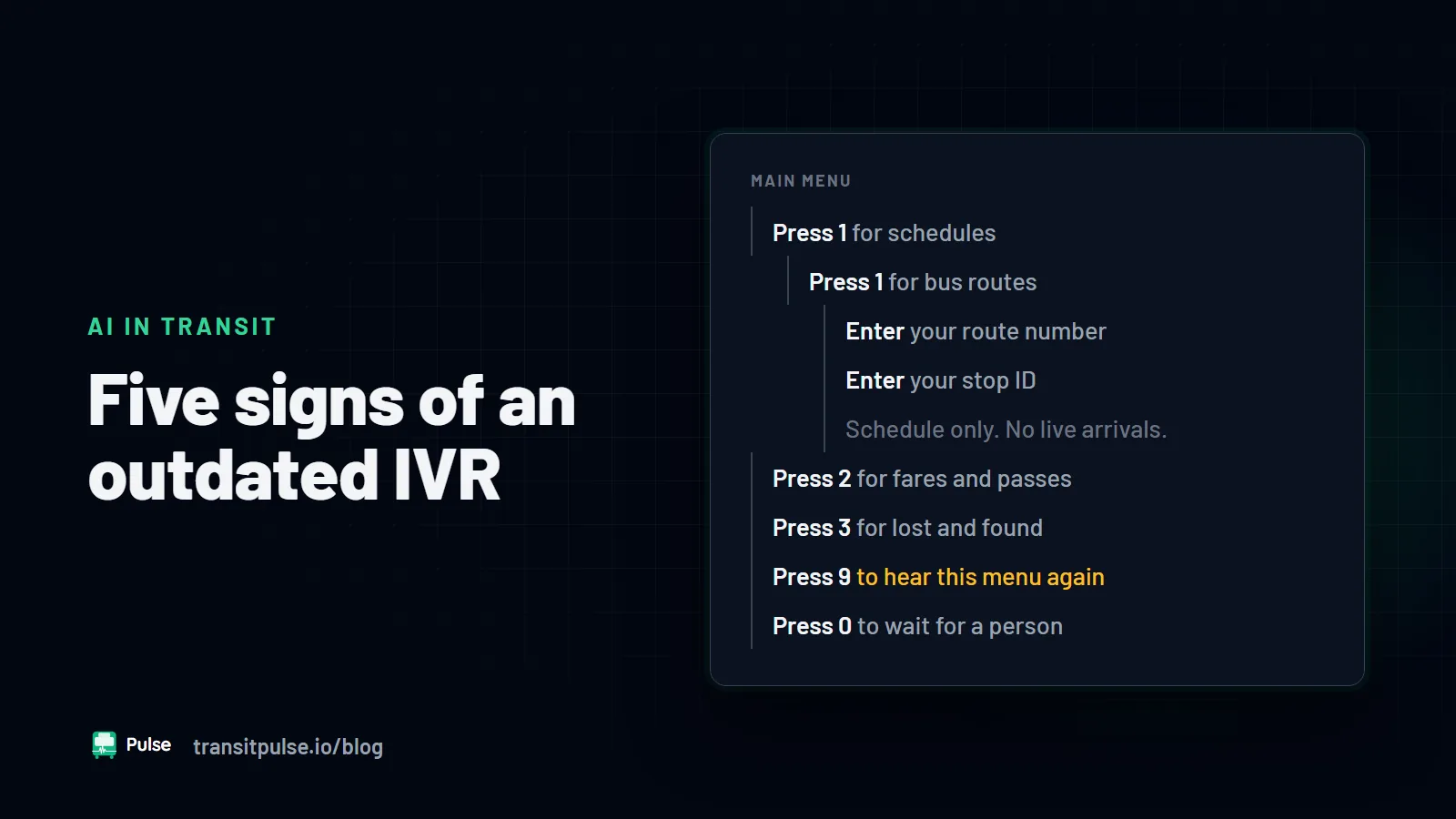
A traditional IVR plays recorded or synthesized prompts on fixed branches. The caller presses a key or says a short word, and the system moves to the next branch. At the end of a branch, the caller hears a recording or goes to a queue.
The IVR was built for call routing. It sorts a large number of calls into the right queues, and it does that job well.
- Strong at: sending callers to the right department and playing a short fixed message. It also collects keypad entries, such as an account number.
- Weak at: questions that are specific, change by the minute, or do not fit a branch someone built in advance.
What an AI voice agent does
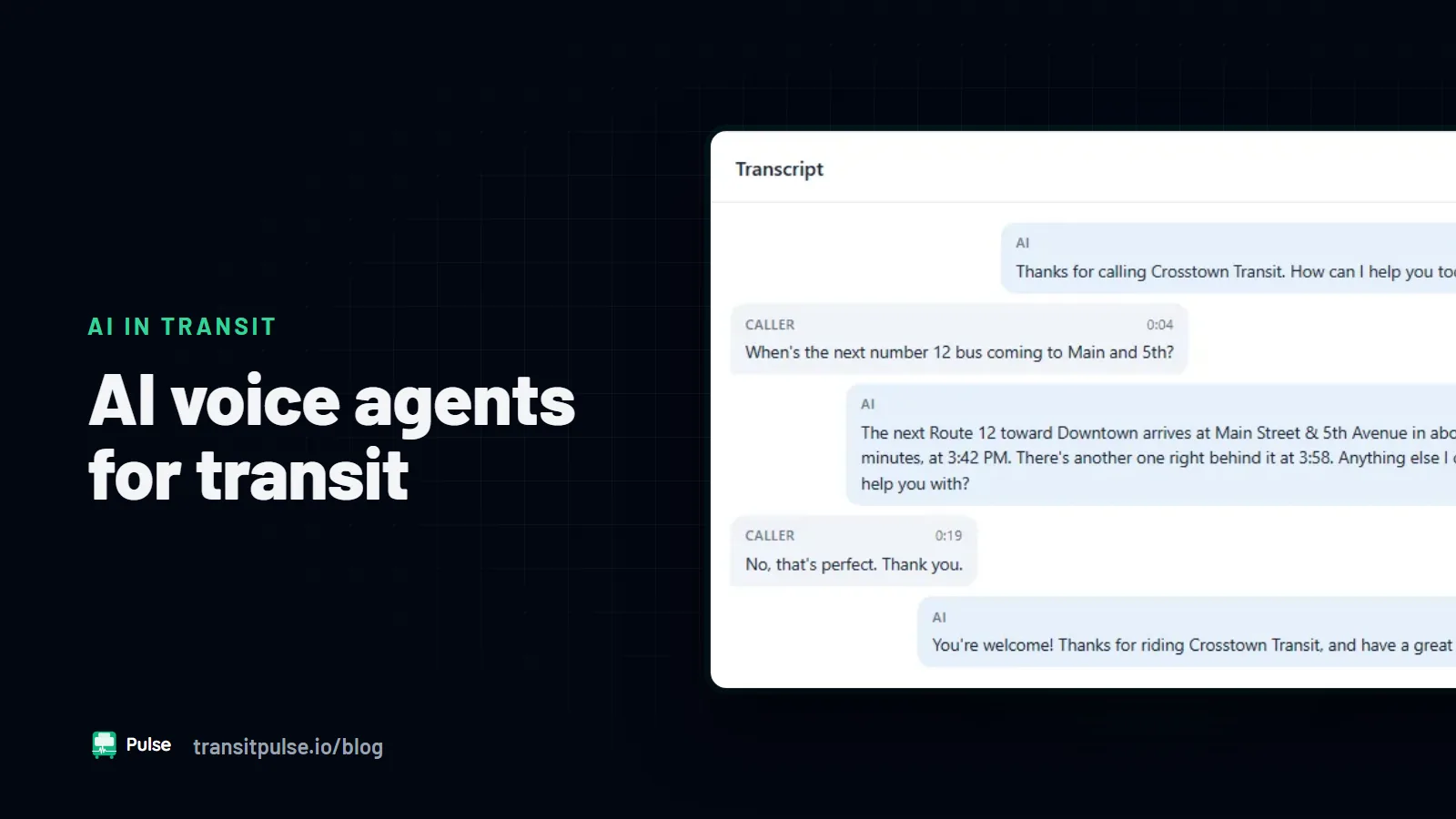
An AI voice agent holds a conversation. The rider says what they want in their own words, and the agent works out the request. It then looks up the answer in a data source and speaks it back.
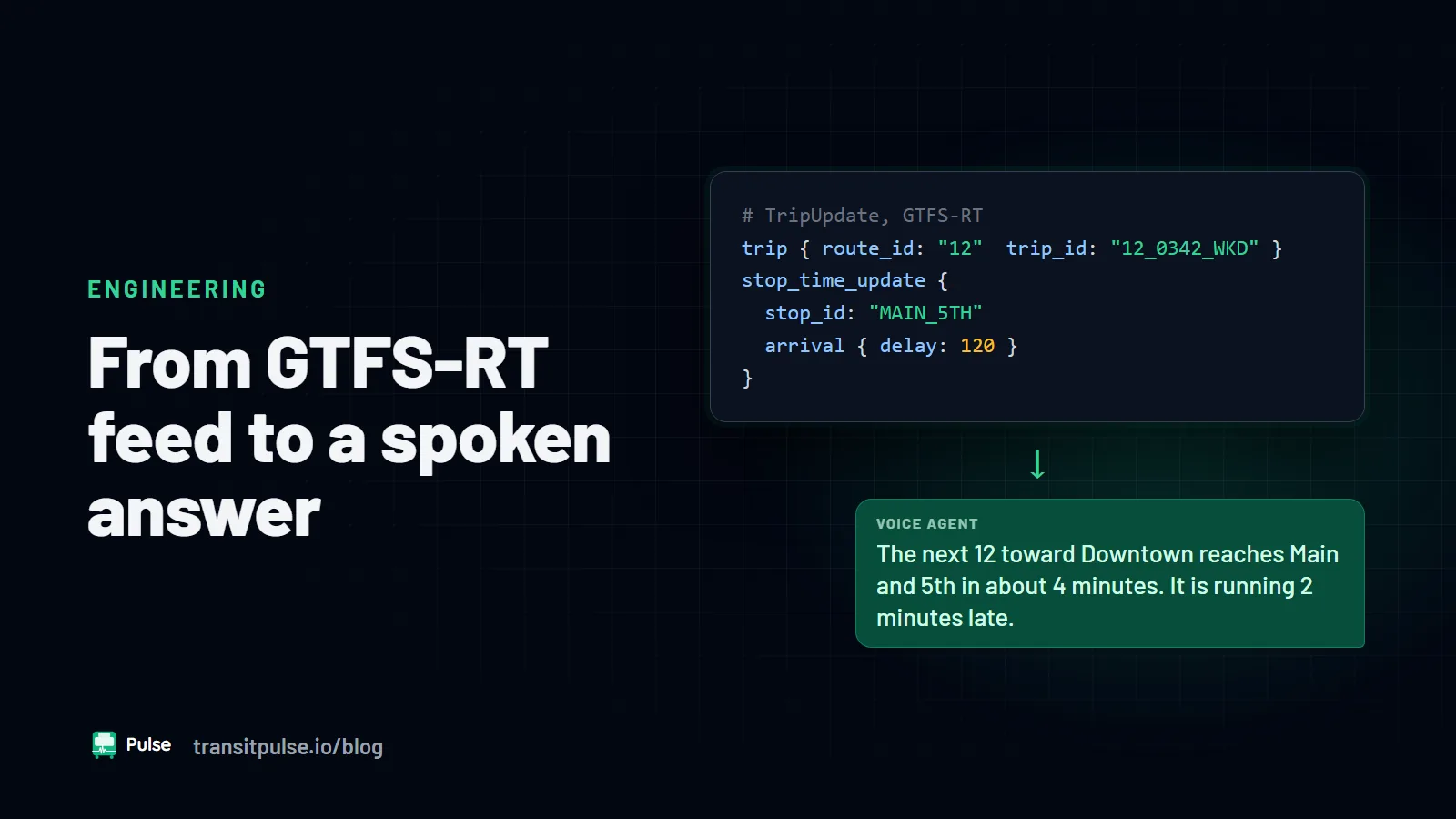
For transit, the main data sources are the agency's GTFS and GTFS-RT feeds. GTFS covers routes, stops, and schedules. GTFS-RT covers arrival predictions and service alerts. The post How GTFS-RT Turns Real-Time Transit Data Into Voice Answers explains how those feeds become spoken answers.
- Strong at: answering the most common rider questions from start to finish, at any hour.
- Weak at: anything outside the data it can read. An agent without a real-time feed can only read the printed schedule.
How they compare, point by point
How the rider interacts
With an IVR, the rider presses keys or says short menu words. With an AI voice agent, the rider asks a question in normal speech.
Where the answers come from
An IVR plays prompts that staff recorded or typed in advance. An AI voice agent reads live data, such as GTFS-RT arrival predictions and alerts.
"Where is the 22 right now?"
A typical IVR cannot answer this question. It sends the rider to a person or to the app. An AI voice agent with a GTFS-RT connection can answer it directly.
When a route changes
An IVR needs someone to update the prompts by hand. An AI voice agent uses the new data as soon as the feed changes.
Handoff to a person
Both can transfer a caller to staff. Ask each vendor what the staff member sees when the call arrives.
Records
An IVR usually logs the menu choices. An AI voice agent can keep a recording and transcript, which help when a rider disputes an answer.
Main goal
An IVR aims to route the call. An AI voice agent aims to answer the question.
Where a plain IVR is still fine
An AI voice agent is not the right answer for every agency or every call. A plain IVR still makes sense in these cases.
- Most calls need a person anyway. Some agencies get few arrival questions and many paratransit, eligibility, or billing calls. A short menu that routes those calls well may be all they need.
- The call is about routing, not information. "Press 1 for paratransit reservations, press 2 for lost and found" is quick and clear. A caller who knows where they want to go gets there fast.
- The agency has no reliable real-time feed. Without GTFS-RT, an AI voice agent can only read the schedule. The gain over a good recorded schedule line is smaller.
- A back-end system needs keypad entry. Some fare account or reservation systems only accept keypad input through the existing IVR. Replacing that link can take more work than it is worth.
- A fallback is needed. A short menu is a sensible backup if the AI system or the data feed goes down.
Using both on one number
The choice does not have to be one or the other. Both can sit on the same phone number, and some setups combine them.
In one common pattern, the AI voice agent answers first and handles arrival and schedule questions. It sends other calls to the right queue, the same job the old menu did. In another pattern, the menu stays and gains a new option that connects the caller to the voice agent. That option suits agencies that want to test the voice agent before they change the main menu.
If most of your calls are arrival questions, the first pattern usually gives riders the shortest path. The article The Next Generation of IVRs? A Transit Agency's Guide to AI Voice Agents covers what to look for in that setup.
Questions to ask vendors
- Does your system read our GTFS-RT feed directly, or a copy that you refresh?
- What does the system say when the feed is down or a prediction is stale?
- What happens when a rider asks something outside fixed-route service?
- How does a caller reach a person, and what does our staff member see?
- Can we review the recording and transcript of any call?
- How long until we are live, if our GTFS feeds are already published?
- Can we keep our existing phone number?
- Is pricing per call, per minute, or by subscription?
A vendor that answers these plainly, in writing, is easier to hold to its promises later.
The short answer
Your riders may mostly ask where their bus is. Then an AI voice agent answers more of their calls than an IVR can. If your calls are mostly about reaching the right office, a plain IVR may still do the job. If your agency falls in between, both can work on one number.
Pulse RideInfo is an AI voice agent built for fixed-route transit. It reads your GTFS and GTFS-RT feeds. It runs as a standalone voice agent or as a replacement for your IVR.