Most complaint records only need to satisfy the rider who filed the complaint. Title VI and ADA complaint records have a second audience. Reviewers, investigators, and attorneys may read them long after the event, and none of those readers were on the call. The record has to show what happened, who did what, and when, without anyone's memory to fill the gaps.
This post covers the record-keeping practice that makes that possible. It follows a complaint from intake to the log.
This post describes general record-keeping practice. It is not legal advice. Your agency's civil rights officer and legal counsel set the policy for Title VI and ADA complaints. That policy includes definitions, access rules, and how long you keep each record. Follow their policy where it differs from anything here.
The two circulars to know
FTA Circular 4702.1B sets out Title VI requirements for recipients of FTA funds. It covers complaint procedures. It also asks recipients to keep a list of Title VI investigations, complaints, and lawsuits.
FTA Circular 4710.1 is FTA's guidance on ADA requirements for transit. It covers the complaint process, among many other topics.
Your civil rights officer knows how your agency applies both circulars. The practices below support that work. They do not replace it.
Step 1: Flag the complaint at intake
The calltaker does not decide whether a complaint has merit. The calltaker decides whether it might be a Title VI or ADA complaint, and flags it. A flag at intake costs little. A civil rights complaint found weeks later in a general queue costs much more.
Give intake staff a short list of signs to listen for:
- The rider mentions race, color, or national origin.
- The rider mentions language access, such as a request for an interpreter or translated material.
- The rider mentions a disability, a mobility device, or a service animal.
- The complaint involves a lift, a ramp, securement, stop announcements, or a pass-up of a rider with a mobility device.
- The complaint involves a paratransit trip, an eligibility decision, or a request for a reasonable modification.
At intake, record the date received, the channel, and the rider's own words. Do not summarize the rider's words into staff language. The original wording often matters most during a review.
Flagging is not a final decision. The civil rights officer may later decide the complaint is general. Then remove the flag, and note who decided and why.
Step 2: Keep these complaints apart from general complaints
A flagged complaint should not follow the general complaint workflow. A general workflow may let a supervisor close a case with "operator coached." A Title VI or ADA complaint needs a review by the civil rights officer before it closes.
- Use a separate type or a clear flag. Staff and reports should both see the difference at a glance.
- Limit access. Only the people who work on the complaint should see the details. Many of these records include health or personal information.
- Link related records. One incident can produce a general complaint and a civil rights complaint. Keep them separate, but link them so an investigator sees both.
- Report them separately. Count them apart from general complaints, so neither number hides the other.
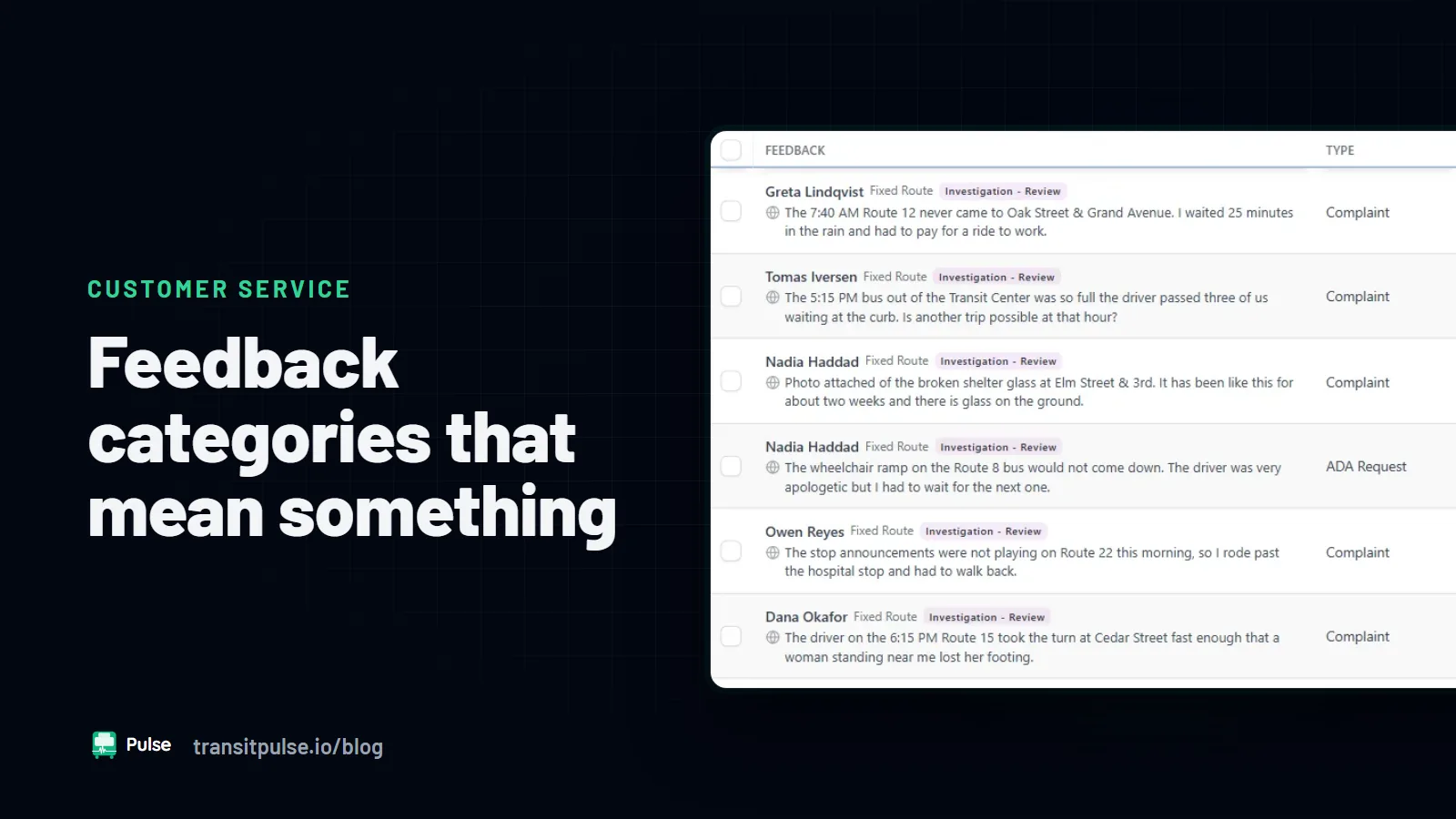
A clear type structure at intake makes this easier. We cover that in Complaint, Commendation, Inquiry: Feedback Categories That Mean Something.
Step 3: Track each step of the investigation
Your procedure defines the steps. For each step, the record should show who acted, what they did, and the date. A typical investigation includes these steps:
- The agency receives the complaint and sends an acknowledgment.
- The civil rights officer assigns an investigator.
- The investigator requests evidence, such as onboard video, vehicle location data, dispatch logs, and operator statements.
- The investigator interviews the complainant, the operator, and any witnesses.
- The investigator writes a finding, and the civil rights officer reviews it.
- The agency sends the response letter.
- The agency records any corrective action and closes the complaint.
Attach evidence to the complaint record. Do not leave it in one person's email or on a shared drive with no link. Request onboard video early. Many video systems overwrite old footage after a set time.
Record the delays too. If the investigator waited on a statement, the record should show the request date and the reply date. A reviewer can then see why a step took longer than planned.
Step 4: Keep the response letter
Keep the letter that the agency actually sent, not a draft. Record the date sent, the method, and the address. If the agency sent the letter in another language or an alternate format, keep that version as well. If the complainant replies or appeals, add the reply to the same record.
Step 5: Keep a log you can produce
A reviewer may ask for a list of Title VI or ADA complaints. The complaint records should produce that list directly. Nobody should rebuild it from email and memory.
A useful log includes these fields for each complaint:
- Complaint ID and date received
- The basis, such as race, color, national origin, or disability
- A short, factual summary
- The current status and the investigator
- The finding and any corrective action
- The date closed and the date of the response letter
Produce the log on a regular schedule as a test. If it takes a day of work, the records have gaps. Fix the gaps before a review or a complaint to FTA exposes them.
Where Pulse Feedback fits
Pulse Feedback gives each feedback type its own fields and workflow. ADA requests follow a different process than a commendation. Agencies add fields and adjust workflows themselves. In an investigation, each stage has an owner. Staff attach evidence to the case and link related investigations. Staff reply from the case, and the whole thread stays with it. Each role sees only its own work.
To see the investigation screen, visit the Pulse Feedback page or contact us.